
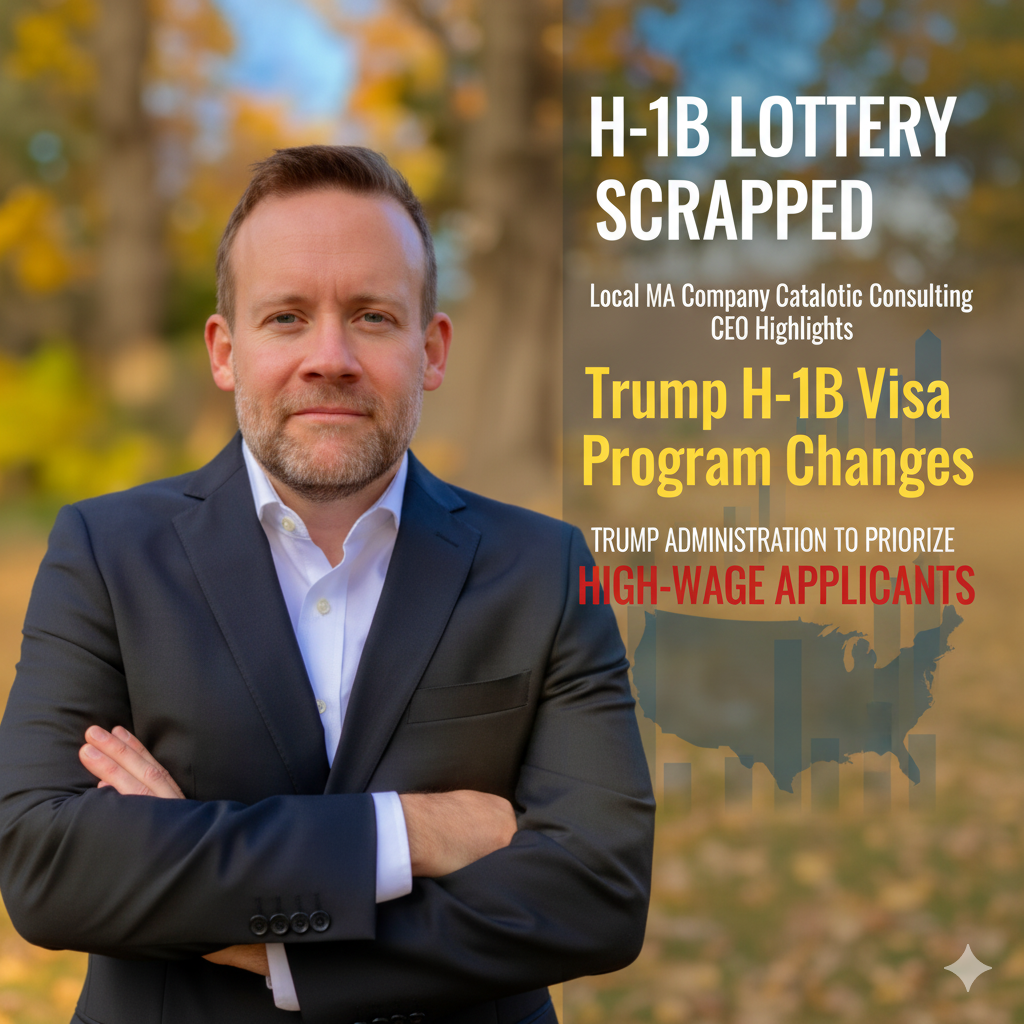
H-1B Policy & Lottery: Today on LinkedIn, I came across a thought-provoking post from Joe Gifford (President, Principal Consultant, and NPDP at Marlborough’s own Catalytic Consulting, Inc). Since June 2020, Joe has specialized in accelerating innovation strategies for organizations of all sizes. His latest thread dives into the changing landscape of H-1B visa policy, offering small/medium/large & start-up companies valuable perspectives for both local Massachusetts-area businesses, and the broader innovation economy.
So Joseph Gifford’s an NPDP is the President and Principal Consultant at Catalytic Consulting, Inc. since June 2020, focusing on enhancing innovation strategies for businesses and he posted the follow posted about H-1B Policy and I didn’t even know it was hitting the news today 09/23/2025.
Local MA Company’s Read: Joseph Gifford NPDP’s [Trump H-1B Policy & Visa Program Change] Post on Linkedin
Joseph Gifford, NPDP President | Principal Consultant | VP/CTO RD&E | Evoqua Siemens Veolia | Water | Renewables | Membranes | Catalyzing Innovation for Startups to Large Corporates
🚨 Big changes are coming to the H-1B visa program. The U.S. government announced plans to impose a $100,000 annual fee per visa in a move that could reshape the way companies hire global talent. You can read more about this in many publications claiming it will kill U.S. innovation.
At the same time, thoughtful critiques like “The H1B Paradox” (https://lnkd.in/e6GZbd-x) point out the program’s two-sided reality: ==> On one hand, H-1Bs are essential for filling skills gaps and fueling innovation in sectors like tech, AI, and biotech. ==>On the other, the program has sometimes been misused, driving down wages, sidelining U.S. workers, and creating dependency for foreign employees.
What could change mean?
- ✅ More protection for domestic talent
- ✅ Pressure to curb systemic abuse
- ⚠️ Risk of losing top global talent and slowing innovation
- ⚠️ Higher barriers for startups and smaller firms
The paradox is clear: H-1Bs are both a critical driver of growth and a system in need of reform. The real challenge isn’t whether to expand or restrict. It’s how to strike the right balance between protecting U.S. workers and maintaining America’s innovation edge. 🤔 Do you think these proposed changes move us closer to that balance or further away?
Will these changes help or hurt U.S. innovation over the long term? ———————————- Want to learn more about me and my business? Check out Catalytic Consulting, Inc. We accelerate innovation through 𝗦𝗧𝗥𝗔𝗧𝗘𝗚𝗬, 𝗣𝗘𝗢𝗣𝗟𝗘, 𝗘𝗡𝗚𝗜𝗡𝗘𝗘𝗥𝗜𝗡𝗚, 𝗮𝗻𝗱 𝗙𝗜𝗡𝗔𝗡𝗖𝗘. “Catalyzing change: from breakthroughs to bottom lines”.

From a geopolitical strategy perspective, long-term national competitiveness cannot be predicated on a perpetual dependency on foreign talent. It creates a strategic vulnerability. This policy, despite its abruptness, forces a necessary reckoning. It incentivizes a reallocation of capital toward building a self-sustaining innovation ecosystem through education and training. While disruptive in the short term, this shock to the system may be the catalyst required to build a more autonomous and secure economic foundation, which is the true bedrock of enduring growth.

Licensed Real Estate Broker | Metro West Home Team Leader | Waltham-Watertown Specialist | Client-Centered Representation | Business Entrepreneur | Community Leader | Creative Professional | Investor8h
Joseph Gifford, NPDP You’ve outlined the core tension perfectly. The challenge isn’t picking sides, but I worry a blunt $100K fee might damage what works without actually fixing the real problems in the current system.

Your local insurance expert, Brian Plain, helping you find the best auto and home quotes4h
Great post, Joe! It’s a complex issue, and your breakdown of the paradox is spot on. The point about startups and smaller firms is critical. A $100,000 fee could become an insurmountable barrier, effectively creating a “talent moat” that only the largest companies can cross. This would be a huge loss, as many groundbreaking ideas come from agile, smaller teams that rely on one or two key H-1B hires to get off the ground. It makes me wonder if a more targeted reform could be better. Instead of a flat fee, perhaps a system that ties visa priority to higher wage levels (e.g., must be in the 90th percentile for the role/location) or requires a demonstrated investment in training domestic talent. That might be a better way to strike the balance you mentioned…curbing wage depression without stifling the innovation that drives our economy forward.

Data Analyst at Hindustan Unilever6h
Curbing H-1B abuse is long overdue. Protecting U.S. jobs outweighs the loss of some global talent—startups can adapt. I believe this will boost economic growth by keeping money and opportunities in the country, rather than sending them abroad. The tension post-Charlie Kirk’s killing shows we need stability, not more foreign dependency.

uzman bu konuda iyi bir şekilde tecrübe ve iyi bir çalışma azmi kararları mevcut5h
The national interest is not solely defined by corporate R&D output. A policy that strengthens the labor market for U.S. workers, increases aggregate wages, and reduces corporate dependency on a temporary visa program can contribute positively to GDP growth through enhanced consumer spending and broader tax base. The potential slowdown in certain tech sectors must be weighed against the macroeconomic benefits of a healthier, more equitable labor market. This is a recalibration toward endogenous growth, not a rejection of growth itself.
Designing websites that make you💰and save you ⏰ | Keynote Speaker8h
Joseph Gifford, NPDP This is a fascinating (and concerning) development. A $100K annual fee would fundamentally shift the landscape—not just for big tech, but especially for startups and mid-sized firms that rely on H-1Bs to fill critical roles they can’t source domestically.

Turn People into Profit ➜ I help owner-led companies cut turnover & lift margins in 90 days—without costly perks. #peopleprofitbook8h
Joseph Gifford, NPDP Such an important and nuanced conversation—thank you for laying out both sides so clearly. A $100K fee could be a safeguard or a barrier, depending on how it’s implemented. I wonder—will it level the playing field, or just make innovation harder for startups who can’t absorb that cost?
Holistic M&A Advisor – I sell businesses so their owners can discover “What’s Next?”8h
great post and questions Joseph. I hate to say it, but my answer is, “it depends”, as in, it depends on how the rile is implemented and how we grow US talent to fill these roles.

8h
It’s a complex issue. The fee would most likely hurt small firms the most, creating an uneven playing field for global talent. Thank you for sharing your balanced take, Joseph Gifford, NPDP!

WOW. This is big news and I have not heard about this. Thanks
Learn more about how your Massachusetts business can find local solutions to your needs, with Joseph Gifford, NPDP.
Read Top 9 Details: Trump Administration Proposes Prioritizing High-Paid H-1B Applicants and Imposes $100,000 Visa Fee to Protect U.S. Worker Wages
- Proposal favors higher–paid H–1B applicants if demand exceeds supply; Trump administration cites need to protect wages of U.S. workers;
- Learn more about “Trump H-1B Visa Program Changes Trump Administration to Prioritize High-Wage Applicants “after announcing a new $100,000 fee on H-1B visas, the Trump administration on Tuesday proposed overhauling the visa’s lottery selection process” on NBC news.
- President Trump signed a proclamation on September 19, 2025, increasing the fee for new H-1B visa petitions to $100,000.
- The new fee became effective on September 21, 2025.
- The purpose of the fee increase is to deter the abuse of the H-1B program and encourage employers to hire U.S. workers.
- The changes do not apply to existing H-1B visa holders or to petitions submitted before September 21, 2025.
- The proclamation does not affect fees for H-1B visa renewals.
- The policy could impact US university intake, as many international students opt for countries where they can later obtain a work visa.
- The fee is typically paid by employers on behalf of workers.
Trump H-1B Visa Program Changes Highlights FAQ
- President Trump signed a proclamation on September 19, 2025, increasing the fee for new H-1B visa petitions to $100,000.
- The new fee became effective on September 21, 2025.
- The purpose of the fee increase is to deter the abuse of the H-1B program and encourage employers to hire U.S. workers.
- The changes do not apply to existing H-1B visa holders or to petitions submitted before September 21, 2025.
- The proclamation does not affect fees for H-1B visa renewals.
- The policy could impact US university intake, as many international students opt for countries where they can later obtain a work visa.
- The fee is typically paid by employers on behalf of workers.
Is your Massachusetts or online business in need of the best ways to start “Architecting an Agentic AI system“? It requires some level of detail regarding the technologies you use to drive results, customization is key to getting the “Best AI Results”.
Call us at 1-508-630-4355 or visit NextAICompany.com to “get started with AI in Massachusetts” for your small company or business with Next AI Company LLC’s Best Hybrid LLM/SLM/OLM “Agentic AI Solutions for Massachusetts”, with NextAICompany.com’s Agentic AI System’s Architect & CEO Brian Plain .
Find our Top 5 NextAICompany.com Massachusetts Small Business Powerful Prompts
- “Draft a concise meta description (155 chars) for this LinkedIn post highlighting key points”
- “Create three headline options for a blog post based on Joe Gifford’s thread”
- “Rewrite the LinkedIn thread into a 150–200 word local-news blurb”
- “Convert the post into a short email newsletter subject + preview text”
- “Suggest five SEO keywords to target for an article about the H-1B fee proposal”
To learn more about “H-1B Visa changes for Massachusetts companies“, visit the H-1B FAQ